|
Goju-kai Karate-do is a mixture of traditional martial arts in Okinawa and
traditional martial arts, mainly Chinese Nanpa Kenjutsu in Fuchien
province, China. During Ryukyu age, peasants couldn't have any arms
because of the government's power policy. These peasants who developed
martial arts called Te, fought with bare foot and bare hands. This martial
arts was the beginning of Karate, and later, it was called To-dei.
On the process of spreading over in Okinawa, Naha-te, Shuri-te, and other
Style's origins were established. Goju-kai, which originated from Naha-te
was established by Chojun Miyagi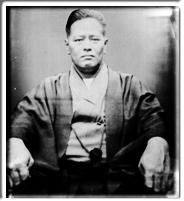 Sensei, who was a disciple of Kanryo Higaonna Sensei, the master of Naha-te.
At the age of 16, Chojun Miyagi went to China and studied Karate under
many renowned Karate masters. He also studied about theory and completed
special breathing way called "Kisoku no Donto".
Sensei, who was a disciple of Kanryo Higaonna Sensei, the master of Naha-te.
At the age of 16, Chojun Miyagi went to China and studied Karate under
many renowned Karate masters. He also studied about theory and completed
special breathing way called "Kisoku no Donto".
Goju-ryu named after a line from Chinese old literature named "Bubishi".
Chojun Miyagi improved old training way and established rational program
including warming-up exercises, Kihon-kata, and Kaishu-kata, assistant
exercises and so on. He thought character building was important so he
left many his words.
In the year 1937, Dainippon Butoku-kai awarded him the title, "Karate-do
Kyoshi-go". Karate-do received a good reputation and this moment was a big
step to spread Karate all over the Japan.
According to Goju-kai's spirit, all existence consists of Go, or hardness
which becomes positive and Ju, or softness which becomes negative. At
fight, Go becomes offence and Ju becomes defense for protecting us safety.
Mixing Go and Ju leads a tranquil mental state to prevent the fighting. |